
Review of “China Just Built What America Feared Most” (YouTube, 16 Oct 2026) · Nov 16, 2026 ·
Executive summary
The video’s main argument holds. China is building AI compute at a scale second only to the US, with cheap energy and state finance on its side. Chips and memory are what hold it back. The video’s numbers are loose, though, and it leaves out the parts that matter most for DIE. Five findings:
- China’s binding constraint is silicon, not energy. The US case runs the other way. Ch6 §6.2 says energy is “the only real constraint”. That holds for the US, where it can take years to get connected to the grid. It does not hold for China, which added 543 GW of generating capacity in 2025. China is short of advanced logic and HBM. That flips the case for orbital compute. The US has a reason to move compute to where the energy is. China can stay on the ground longer and use orbit for sovereignty and edge processing.
- China runs the Arena Designer playbook in a stronger Hamiltonian form. Local governments line up land, power and financing. State credit lines (for example ¥57.7bn to Orbital Chenguang) and a few favoured hyperscalers get the new money first. That is the Ch6 Cantillon mechanism with the state as the explicit first recipient.
- In China’s mesh, the “exit” valve is shut. Capital controls and the ban on crypto trading leave Chinese savers without the hard-money shock absorber that Ch6 §6.7 relies on. If the Ch6 thesis is meant to apply globally, it needs a jurisdiction clause.
- The hole in US dominance comes from the system, not the chip. Huawei offsets weaker chips with SuperPoD scale-up, near-packaged optics and the UnifiedBus interconnect. DeepSeek and Huawei are open-sourcing tools that bypass CUDA. Beijing is deliberately holding back H200 imports. EUV is still the chokepoint that holds. HBM is wearing down, and CUDA is wearing down fastest.
- SPCX’s moats hold against China. The real threat is compute deflation. Launch cadence, Starlink spectrum and the vertically integrated stack have a lead of five years or more. China competes for the Global South and its home market, not for SPCX’s customers. The risk to the valuation is that cheap Chinese compute (and open weights) erodes margins in the Super Intelligence segment.
Update, 17 Nov (second video): China leads on time in orbit: Three-Body has run 8B models since May 2025, and Chaozhisuan-1 launched in Sep 2026. SPCX leads on compute per satellite and lift. The two serve different markets, edge inference versus bulk compute, split by law, so demand leaves room for both. The zero-sum fight is over LEO shells and spectrum. See “Second video: facts vs friction” and “The orbital race”.
Fact-check: what the video gets right and wrong
About half of the video’s hard numbers check out. The rest are garbled, out of date, or impossible to verify. For the corpus, treat it as a field report from a chip engineer, not as a primary source. The three claims it can’t stand behind are the 1,024-NPU SuperPoD, the 550 kW saving and the 12.5 GW for Ulanqab.
| Claim in the video | Verdict | What the sources say |
|---|---|---|
| China has ~30 GW of data centres, with ~20 GW in the pipeline; the US expects ~60 GW | Unverified | No primary source given. Plausible in scale. Keep these as the video’s estimates. |
| 16 racks × 64 NPUs = a “1,024-NPU Atlas 950 SuperPoD” | Wrong | Huawei specifies the Atlas 950 SuperPoD at up to 8,192 Ascend 950DT in 160 cabinets (Reuters via TradingView). The NPO-based Atlas 960E holds up to 4,096 (Huawei). The video may have been describing a demo configuration. |
| Hi-ONE near-packaged optical engine | Correct | 7.2 Tbit/s, which Huawei calls the first mass-produced NPO engine. It was launched in the Atlas 960E at Huawei Connect, 17 Sep 2026 (Fierce Network). |
| Saves “more than 550 kW per SuperPoD” | Unverified | Huawei’s claim, repeated in the video. No independent measurement. |
| 256,000-NPU systems already being deployed; roadmap to 1 million | Correct (as claimed by Huawei) | Huawei says an Atlas 950 SuperCluster with 256,000 cards is being deployed (CRN Asia). |
| TileLang lets one codebase run on Nvidia and Ascend | Mostly correct | DeepSeek ported TileLang, DeepGEMM, DeepEP and FlashMLA to Ascend on 30 Sep 2026. TileLang itself was created by the tile-ai project, not by DeepSeek (pasqualepillitteri.it). Independent replication was still pending at the end of September. |
| SMIC running at “almost 95%” in Q2 2026 | Imprecise | 93.7%. Management caps utilisation at about 95% and keeps the rest for R&D (Herald Corp). |
| HiBL 1.0 / HiZQ 2.0 HBM announced “September last year” | Correct | Announced at Huawei Connect, Sep 2025 (Converge Digest). |
| CXMT can supply HBM | Overstated | HBM3 yield reportedly stalled near 25%. HBM3E is going into limited production at 20–30% yields (TrendForce). |
| Ulanqab: 19 projects, 12.5 GW planned | Unverified | No primary source found. Treat it as planned capacity on paper, not capacity under construction. |
| Supply catches demand around 2029 (global) and 2030 (China) | Opinion | Forecast from a roundtable. The video itself calls it an estimate. |
A disclosure note: the video carries a sponsor segment for an AI aggregator. That has no bearing on the analysis but should be logged in the corpus entry’s provenance.
Through the Chapter 6 lens
The video describes Chapter 6’s mechanism without naming it. Its “fear of missing out” among provinces is the Cantillon effect seen from the ground: whoever wins the campus gets the new money first.
Cantillon: who stands closest to the money
Ch6 says the orbital-compute complex “buys energy, silicon, and land before the expansion reaches the price level.” China has its own version of that complex, in three rings:
- First ring: state credit and local governments. Provinces compete with cheap land, power and financing. Beijing has given Orbital Chenguang about ¥57.7bn (~$8.4bn) in credit lines (carboncredits.com). This is stealth QE through policy-bank credit, not central-bank balance sheets.
- Second ring: the five hyperscalers. By the video’s own estimate, about 60% of the new capacity goes to ByteDance, Alibaba, Tencent, Baidu and Huawei. They lock in power at Inner Mongolian prices, which the video puts at roughly half of Beijing’s.
- Third ring: the supply chain. SMIC raised wafer prices for Q3 2026 and grew Q2 revenue about 36% year on year (Mexico Business News, Webull). Huawei, Cambricon, MetaX and Iluvatar CoreX reportedly raised AI-chip prices by 20–50% as memory costs rose (TrendForce). Inflation shows up in the inputs before it shows up anywhere else.
Debasement masked by deflation, Chinese version
In China the mask is thicker than in the US. Headline consumer prices have been near zero and producer prices deflationary. So compute deflation hides credit expansion against a background that already reads as “no inflation”. The Ch6 claim that “the number that would reveal it does not exist” applies even more strongly here.
Energy: the constraint flips
China added 315 GW of solar and 119 GW of wind in 2025, and total capacity reached 3.89 TW (pv magazine). It added 543 GW from all sources (FMT/Reuters). “East Data, West Compute” moves the computer to the energy on land, which is the same move Ch6 attributes to orbit. Energy is not scarce for China. What is scarce is the silicon to turn that energy into intelligence.
This gives Ch6 a useful asymmetry:
| United States | China | |
|---|---|---|
| Binding constraint | Deliverable energy (grid interconnect queues) | Advanced logic (no EUV) and HBM yield |
| Why go to orbit | To escape the grid: energy acquisition | Sovereignty, edge processing, and to stake orbital slots and spectrum |
| Where waste heat goes | Expensive in vacuum (the radiator constraint) | Cheap on land: Ulanqab averages about 4°C |
| Who funds it | Capital markets + state (an IPO, CHIPS-style subsidy) | Policy banks + local governments + state credit lines |
Outside money: the shut valve
Ch6 treats hard money held outside the system as the shock absorber for the mesh’s purchasing power. Chinese savers cannot use it. Capital controls and the crypto-trading ban close that exit, and savings are pushed into property, bank deposits and state-directed equity. So the Chinese mesh absorbs both squeezes Ch6 describes (debasement and labour deflation) with no way out. Ch6’s obligation on arena designers is therefore stronger in China, and the means of meeting it (a fitness function that preserves purchasing power) would have to be state-issued. A permissionless credential like the Values Passport would not work there.
China’s roadmap: terrestrial and orbital
China can break through, but only on the ground and only if it clears two fabrication gates: HBM yield around 2027–28, then an EUV-class node after that. Energy and launch are not the bottleneck. Orbital compute is a 2035 project, about a decade behind its terrestrial build-out.
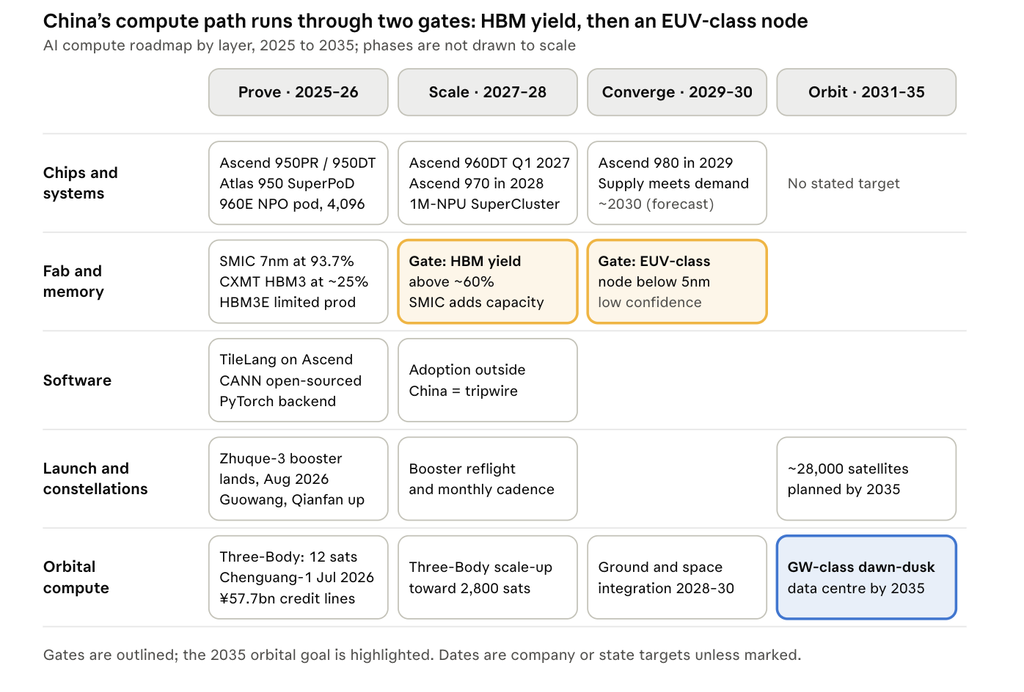
Chips, systems and launch are on or ahead of schedule. Huawei pulled the Ascend 960DT forward to Q1 2027. Memory and lithography decide whether the 2030 “supply meets demand” forecast holds.
There are two ways this could break US dominance. At home: system-level brute force (SuperPoDs plus NPO plus UnifiedBus on cheap western power) can make up for weaker chips, because China pays less per watt. Abroad: a complete sovereign stack for the Global South (Huawei hardware, open weights, Chinese launch and constellations) offered as an alternative to the US one. The US model assumes the EUV, HBM and CUDA chokepoints last. CUDA is eroding fastest, HBM next, EUV slowest.
Second video: facts vs friction
“China Already Has AI Running in Space. SpaceX’s Won’t Launch Until 2027” (YouTube, 19 Oct 2026) gets the hardware facts mostly right. The friction is in its framing: it compares a small-satellite edge-inference network with a rack-scale data-centre satellite as if they were the same product. China is ahead on time in orbit. SpaceX is ahead by orders of magnitude on compute per satellite and on launch capacity.
| Claim in the video | Verdict | What the sources say |
|---|---|---|
| Three-Body launched 12 satellites in May 2025, each running an 8B-parameter model | Fact | After about nine months of testing, Zhejiang Lab reported networking, computing and model deployment, including 8B-parameter remote-sensing and astronomy models (eHangzhou/Xinhua) |
| Six satellites ran under one distributed operating system by Feb 2026 | Partly verified | The Feb 2026 report confirms networked computing. I found no primary source for “six satellites, one OS” |
| A general-purpose LLM runs in orbit | Fact (company claim) | ADA Space uplinked Alibaba’s Qwen3 and ran inference on orbit (China Daily). Inference only, not training |
| Gamma-ray-burst triage in orbit | Fact | Detection and alerts for follow-up observation were part of the mission from launch (OODA Loop) |
| Laser links at 99.99% uptime over 8 days | Fact, but narrower | Two satellites held one link for just over 192 hours, at up to 1,000 km apart (China in Space). One link between two satellites, not a mesh |
| 100 Gbps inter-satellite links | Fact | Per-satellite laser links of up to 100 Gbps (Xataka On). Starlink already flies 100 Gbps crosslinks (TS2) |
| A startup closed a 400 Gbps laser link | Fact, dated | Laser Starcom announced it in Mar 2025, not recently (IEEE Spectrum). The test lasted 6 min 44 s (MERICS) |
| 2,800 satellites: 2,400 inference + 400 training; commercial around 2030 | Fact (company plan) | That split is ADA Space’s own claim (SpaceNexus). Full build-out is 2035 (China Daily). The video blends this with Zhejiang Lab’s separate target of 1,000 satellites by 2032 (CGTN) |
| “Kazuan 1”, a shared AI-processing satellite backed by SenseTime and Zhipu | Fact, misnamed | It is Chaozhisuan-1, launched 20 Sep 2026 on Kinetica-1. Its alliance includes Zhipu AI, SenseTime and Tsinghua (Tech Times). It launched about a month before the video, not “this past week”. It is a single demonstrator with no disclosed compute specification |
| Backers are on US restricted lists | Fact | Zhipu has been on the Entity List since Jan 2025, and SenseTime since 2019 (Tech Times) |
| Operators must share with state intelligence | Fact (the law); scope is interpretation | Article 7 of the 2017 National Intelligence Law requires organisations to cooperate with intelligence work. Applying it to imagery processed in orbit is an analysts’ reading (Tech Times) |
| Starmind filed in June 2026; AI1 unveiled a month later | Wrong dates | The FCC filing for the orbital data centre was 30 Jan 2026 (Introl). AI1 was unveiled 9 Jun 2026 (Let’s Data Science) |
| AI1 launches late 2027 at the earliest | Mostly fact | Musk targets Q4 2027 for the first AI1, built on Nvidia’s Vera Rubin NVL72, with scale-up in 2028 (VKTR). Other reports say two prototypes fly in early 2027 (Let’s Data Science) |
| “China holds the working hardware; SpaceX holds the paper” | Friction | True for time in orbit. Misleading for capacity: all 12 Three-Body satellites together deliver about 5 POPS (Human Progress/SpaceNews). A single AI1 is designed around a full rack drawing 120 kW on average |
The main correction the video needs: China leads in operating heritage; SPCX leads in compute density and lift. These are different races. China optimises for bandwidth, processing data where it is collected. SPCX optimises for energy, putting bulk compute where the sunlight is.
The orbital race: room for both?
Yes, there is room for both on demand. The two sides sell different products into markets that law has already split. The zero-sum contest is over three finite inputs: LEO shells and spectrum, heavy-lift launch, and customers in the Global South.
Why demand doesn’t force a winner. SpaceX targets 1 GW of annual space-based AI compute by 2027 (Tech Times). The whole Three-Body build-out aims for 1,000 POPS (China Daily/Xinhua). That is an edge-inference network, not a gigawatt data centre. The two programmes barely overlap in capacity. Both are tiny next to terrestrial demand: SPCX alone runs 1.7 GW on the ground.
Why the markets are split. Western governments and regulated enterprises will not route data through operators backed by Entity-List firms and subject to the National Intelligence Law. Starlink is not licensed in China. So each side has a closed home market, and they meet only in third countries.
| Segment | China | SPCX | Head-to-head? |
|---|---|---|---|
| Edge inference on sensor data (Earth observation, astronomy, alerts) | Leads: Three-Body in orbit since May 2025; Chaozhisuan-1 since Sep 2026 | Not a stated focus | Low |
| Bulk AI compute in orbit (training/inference at GW scale) | Chenguang targets GW-class by 2035; Chenguang-1 flying | AI1 targeted Q4 2027 on Vera Rubin; 1M-satellite filing | Low before 2030 |
| Backhaul and connectivity for agents | Guowang + Qianfan, ~28,000 satellites by 2035 | Starlink 9,000+ satellites, V3 on Starship | High in the Global South |
| Orbital shells and spectrum | ADA Space’s 2,800 satellites cleared at the ITU (China in Space) | FCC filing for up to 1M satellites | Zero-sum: LEO shells are finite |
| Heavy lift | Zhuque-3 landed Aug 2026; no reflight yet | Starship in revenue service | SPCX lead of 5+ years |
What this means for SPCX’s ambition to dominate orbital compute:
- The capacity lead is safe; “first” is not. China owns the “first working AI in orbit” story. That costs SPCX nothing in revenue, but it dents the narrative premium priced into the orbital option. The Fool already calls orbital compute a long-shot option stacked on launch and Starlink (Motley Fool).
- The real threat is China’s thesis, not its hardware. If processing data where it is collected (the bandwidth thesis) proves cheaper than escaping the grid (the energy thesis) for most orbital workloads, China’s small, cheap satellites capture the useful middle of the market. SPCX’s rack-in-orbit would be left with bulk training, where the radiator constraint in Ch6 bites hardest.
- GW-class orbit needs lift China doesn’t have yet. 2,800 small satellites are within China’s reach. A gigawatt dawn-dusk data centre needs Starship-class lift and on-orbit assembly. Until Zhuque-3 reflies at cadence, SPCX’s moat at gigawatt scale is launch, not compute.
- AI1 depends on Nvidia. It is built on a space-optimised Vera Rubin NVL72 (VKTR). That ties SPCX’s orbital roadmap to Nvidia’s cadence and to how well that hardware tolerates radiation. China’s satellites use domestic accelerators: smaller, but outside the reach of export controls.
The DIE reading: once energy is free in orbit, scarcity moves to the slots. ITU and FCC filings hand out LEO shells and spectrum largely by order of filing, before any price is discovered. That is the Cantillon effect applied to orbital real estate: whoever files first takes the shell at yesterday’s price. Expect both sides to over-file (1M satellites; 2,800 + 28,000) to claim the commons. Watch slot hoarding, not launch dates, as the leading indicator.
Where to follow China’s orbital compute
The best sources are China-space specialists and primary filings, not YouTube explainers. Each one below is linked to the specific page I used.
| Source | Type | Why it’s useful |
|---|---|---|
| China in Space | Specialist newsletter | Reads Chinese-language releases closely; precise on what was tested (e.g. the 192-hour laser link) |
| SpaceNexus orbital data-centre tracker | Program tracker | Stage-by-stage status of ADA Space, Orbital Chenguang and others; separates confirmed facts from company claims |
| ADA Space HKEX filings | Primary (prospectus) | Legally bound disclosures on the 2,800-satellite plan and ITU approvals |
| Zhejiang Lab via Xinhua / eHangzhou | Official | First-party test results for Three-Body |
| Beijing Municipal S&T Commission via China Daily | Official | The three-phase plan for the gigawatt space data centre |
| IEEE Spectrum | Engineering press | Technical context on laser links (Laser Starcom) |
| MERICS | Think tank | State-capital links behind the start-ups (e.g. the China Development Bank fund behind Laser Starcom) |
| Light Reading | Telecom trade press | Commercial angle: SenseTime × ADA Space, and the gap with Starlink |
| Tech Times on Chaozhisuan-1 | News analysis | The sanctions and National Intelligence Law angle, with a sober comparison to SpaceX |
Also worth tracking, though I haven’t linked them here: SpaceNews (Andrew Jones covers Chinese launches) and the ITU’s satellite network filings database, which is the leading indicator for slot hoarding.
Who the players are
China’s challenge comes from about fifteen entities across six layers. Only Huawei spans more than two of them, which makes it China’s nearest counterpart to SPCX’s vertical stack.
| Layer | Entity | Role | Latest marker |
|---|---|---|---|
| Accelerators + systems | Huawei (Ascend, Atlas, Kunpeng, CANN, UnifiedBus, Hi-ONE) | NPUs, SuperPoDs, interconnect, software | Atlas 960E SuperPoD with NPO, Sep 2026; Ascend 960DT pulled forward to Q1 2027 (CRN Asia) |
| Accelerators | Cambricon, MetaX, Iluvatar CoreX | Second-tier AI chips | Raised prices 20–50% on memory costs (TrendForce) |
| Foundry | SMIC; Hua Hong | 7 nm-class logic via DUV multi-patterning | Utilisation 93.7% / 102.8% in Q2 2026 (TrendForce) |
| Memory | CXMT; XMC, YMTC, JCET (packaging) | DRAM → HBM3/3E | HBM3E limited production at 20–30% yields (TrendForce) |
| Software + models | DeepSeek; Qwen (Alibaba) | Open weights; TileLang/DeepGEMM/DeepEP/FlashMLA on Ascend | Ascend stack open-sourced 30 Sep 2026 (The Next Web) |
| Compute demand | ByteDance, Alibaba, Tencent, Baidu, Huawei Cloud | ~60% of new capacity (video’s estimate) | Licensed for H200 by the US; Beijing withholding import approval (TechRepublic) |
| Orbital compute | ADA Space + Zhejiang Lab (Three-Body Computing Constellation) | Edge inference in orbit; 2,800 satellites planned | First 12 in orbit May 2025; HKEX listing attempt filed 2026 (Mexico Business News) |
| Orbital compute | Orbital Chenguang (Beijing Orbit Twilight Technology), backed by the Beijing Astro-future Institute | Gigawatt-class dawn-dusk data centre by 2035 | Chenguang-1 launched 24 Jul 2026 (SpaceNexus) |
| Orbital compute | CASC | State prime; gigawatt space computing in its 15th Five-Year Plan | Plan-level only (carboncredits.com) |
| Launch | LandSpace (Zhuque-3); SAST (Long March 12A); CAS Space (Kinetica) | Reusable lift for constellations | Zhuque-3 first booster landing, Aug 2026 (Spaceflight Now) |
| Constellations | China SatNet (Guowang, ~13,000 satellites); Qianfan / Thousand Sails (~15,000) | Starlink equivalents; backhaul for orbital compute | Nearly 28,000 satellites planned by 2035 (Jiemian) |
| Policy | Beijing Municipal S&T Commission; NDRC (East Data, West Compute: 8 hubs, 10 clusters) | Land, power, credit | 15th Five-Year Plan (2026–2030) |
| Orbital compute | Chaozhisuan Beijing Technology (alliance: Zhipu AI, SenseTime, Tsinghua) | Shared in-orbit AI processing node for other satellites | Chaozhisuan-1 launched 20 Sep 2026 on Kinetica-1 |
| Orbital compute | SenseTime × ADA Space (SenseTime Space Computing Constellation) | Thousand-satellite compute network; hybrid space-ground backbone by 2028 | Four verification satellites planned for 2026 |
| Laser links | Laser Starcom | Inter-satellite laser terminals; backed by a China Development Bank fund | 400 Gbps inter-satellite test, Mar 2025 |
For the HK-listed-proxy analysis in the corpus: SMIC (0981.HK), Hua Hong (1347.HK), and the pending ADA Space listing are the investable proxies. Huawei, LandSpace and Orbital Chenguang are private. One Orbital Chenguang stake runs through Shunhao (002565.SZ, 23.78%), which is A-share only.
Will SPCX retain its moats?
Yes against China, through at least 2030. The physical moats (launch, spectrum, the integrated stack) are years ahead and sit in a market China can’t sell into. The exposed part is the Super Intelligence (SI) segment. It is now SPCX’s largest line, and it sells a product, terrestrial compute, that Chinese hardware and open weights are pushing toward commodity pricing.
Why that matters: in Q3 2026, SI brought in $7.56bn of $14.58bn total revenue and absorbed more than $16.4bn of the $19.6bn capex (FourWeekMBA, Digg/CNBC). Q3 annualises to about $58bn, against the company’s reaffirmed $100bn run-rate target for the end of 2026 (MarketBeat). The corpus’s $60–70bn “realistic” ARR correction still looks right.
| Moat | Strength now | China’s challenge | Outlook to 2030 |
|---|---|---|---|
| Launch cost + cadence (Falcon 9, Starship) | Very strong: 35 launches in Q3; Starship Flight 14 delivered 26 V3 satellites | Zhuque-3 landed a booster in Aug 2026; no reflight yet; the target is under ¥20,000/kg | Holds. China needs reliable reuse and cadence. Expect a 5+ year gap |
| Starlink constellation, spectrum, laser mesh | Very strong: 9,000+ satellites; V3 adds ~10× the downlink of a Falcon 9 batch | Guowang + Qianfan plan ~28,000 satellites by 2035 | Holds in allied markets. Contested in the Global South and Belt-and-Road markets |
| Vertical integration (rocket → bus → network → model → customer) | Strong | Huawei is the only comparable integrator, and it has no launch arm | Holds. China integrates by state coordination, not ownership |
| Access to frontier Nvidia silicon + HBM | Strong | Ascend + CXMT are at least one generation behind on chips and memory | Holds while EUV controls last. This is SPCX’s most policy-dependent moat |
| Terrestrial compute (the SI segment: 1.7 GW nameplate, >2 GW by end-2026 guide) | Moderate: contracts and backlog ($63bn) | Cheap Chinese compute + open weights push down global inference prices | Most exposed. The moat here is contracts, not physics. Compute deflation compresses margins |
| Orbital compute (AI1: 120 kW average; 1M-satellite FCC filing) | Unproven | Three-Body (edge inference) and Chenguang (2035 GW target) are behind, but state-funded and patient | Not a moat yet. The radiator constraint in Ch6 §6.2 applies to both sides equally |
| Capital access (Nasdaq listing, $1.25tn+ merger valuation) | Strong | China funds with policy credit at no cost-of-capital test | Neutral. Each side’s funding model fits its own system |
The DIE reading: SPCX’s moats are physical; China’s challenge is a matter of price. Ch6 predicts that intelligence becomes a commodity whose cost falls toward zero. In that world the winner is whoever owns the scarce inputs: launch, spectrum, orbital slots and power. Selling the output, compute by the GPU-hour, is the weaker position. On that reading SPCX should keep pushing value into the Space and Connectivity layers and treat SI as a customer for them. The current capex mix (about 84% to SI) bets the other way.
Impact on the agentic AI ecosystem
Two compute stacks mean two arenas with two fitness functions. The Values Passport only works across that border if it can carry attestations both sides will accept.
- Agent cost falls faster. Chinese SuperPoDs running on cheap western power, plus open weights (DeepSeek, Qwen), set a global floor price for inference. Ch6’s deflation thesis speeds up. Agents get cheaper per task, and so does the human labour they replace. That squeezes the mesh harder and sooner than a US-only model would predict.
- Agents multiply on open weights. Every open-weight model is a template anyone can deploy with no identity layer at all. That raises the value of admission control at the protocol layer: ERC-8004, proof-of-values, and memory admission as an immune system. Who builds the agent stops mattering. What matters is whether the arena admits it.
- Two identity regimes. China’s agent identity runs through state registration (algorithm filing with the Cyberspace Administration of China). The Values Passport is permissionless and on-chain. Agents crossing the border will need a bridge: an attestation that one regime can check without trusting the other’s issuer. That is Ch6’s verification asymmetry, now across two jurisdictions.
- Honesty is the hardest primitive across the border. Competence can be benchmarked and care can be scoped to a principal. Honesty “to itself” depends on the substrate the agent runs on. If one stack’s model weights or runtime can be compelled by a state, attestations from that stack need a discount. Ch6 has no field for this yet.
- The compute supply sets who holds the most valuable passports. Five Chinese firms will hold about 60% of new capacity (video’s estimate), and SPCX/xAI, Microsoft, Google and Amazon dominate the US side. The agents with the richest attestation histories will run on hyperscaler compute. Reputation then piles up near the point where the money is created: a Cantillon effect for trust, not just for money.
- Orbital edge agents. Three-Body’s in-orbit Qwen3 demo shows agents that act on sensor data without asking the ground (State Space Agency of Ukraine). Agents that act at orbital latency, outside any terrestrial auditor’s reach, are the strongest case yet for passport-before-action over post-hoc audit (Ch6 §6.5).
Critique, proposed Ch6 amendments, open questions
Where the video falls short
- It counts chips and ignores memory economics. HBM yield, not NPU supply, is the near-term gate. That is why Chinese chip prices rose 20–50%.
- It skips Beijing’s own choice. About 600,000 H200s were reportedly sitting in Hong Kong in Nov 2026 because Beijing withheld import approval (Stock Analysis/Reuters). China is choosing self-reliance, not just being forced into it. That makes the build-out a policy decision, not a reaction to sanctions.
- It has no orbital layer. The video stays on the ground, yet China’s orbital programmes (Three-Body, Chenguang, CASC) are the direct counterpart to the SPCX thesis.
- Its “what this means for you” ending is thin. It names attention capture and data handling but misses the monetary transfer, which is the main point for DIE.
Where Ch6 needs amending (proposed for the Amendment Log)
- §6.2: make the binding constraint depend on the jurisdiction. “Energy is the only real constraint” holds for the US. For China the bind is fabrication: no EUV, and low HBM yields. Suggested wording: the binding constraint is whichever input the jurisdiction cannot print: energy where the grid is closed, silicon where the toolchain is.
- §6.1: add a second orbital-compute complex. The Cantillon first-recipient is not just the US orbital complex. The Chinese state-credit complex (policy banks → provinces → hyperscalers/Chenguang) is an equal case, and a more explicit one. This also answers the “Hamiltonian” framing: China runs a stronger Hamiltonian playbook (national credit for national infrastructure) than the US does.
- §6.7: add an exit-availability condition. The hard-money shock absorber exists only where the mesh can legally reach it. Where it can’t, the arena designers’ obligation cannot be met through “exit”. It has to be met inside the fitness function.
- §6.4: the Honesty primitive needs a substrate field. An attestation should record the compute stack and jurisdiction it was produced on, so verifiers can discount compelled substrates.
Roadmap tripwires to watch (where China could break through)
| Tripwire | Signal it is breaking | Earliest plausible |
|---|---|---|
| Domestic EUV or an equivalent | SMIC volume below 5 nm at commercial yield | Not before 2028; low confidence |
| HBM at parity | CXMT HBM3E yield above 60%, HBM4 sampling | 2027–28 |
| Reusable launch at cadence | Zhuque-3 booster reflown and launching monthly | 2027 |
| CUDA erosion outside China | TileLang-on-Ascend adopted by a non-Chinese lab or cloud | 2027 |
| Compute exports | Huawei SuperPoDs sold into the Gulf, ASEAN or Africa at scale | Already being attempted; watch 2027 |
| Orbital at real scale | Chenguang modules docking in orbit; Three-Body above 100 satellites | 2028–30 |
Open questions for the mesh
- If China’s constraint is silicon and the US constraint is energy, does a negotiated swap (energy-intensive training hosted in one, chips from the other) become the equilibrium? Or does each side close its own gap first?
- Can a Values Passport attestation be meaningful when the issuer’s jurisdiction can compel the substrate?
- Is compute deflation from Chinese oversupply bullish for SPCX (cheaper inputs for xAI) or bearish (margin compression in SI)? Which effect dominates by 2028?
Sources
Primary: video transcript, “China Just Built What America Feared Most” (YouTube, 16 Oct 2026); DIE Ch6, The Arena Designers.
- Huawei: Huawei Connect 2026 release · CRN Asia · Fierce Network · Reuters via TradingView · Converge Digest · Tom’s Hardware
- Software: pasqualepillitteri.it on TileLang · The Next Web
- Fabs and memory: SMIC Q2 2026 results (HKEX) · TrendForce, foundry capacity · TrendForce, CXMT HBM3E · Herald Corp
- Export controls: Stock Analysis / Reuters, H200s in Hong Kong · TechRepublic
- Energy: pv magazine, 2025 additions · FMT / Reuters
- China orbital: Mexico Business News, Three-Body · China Daily, Beijing space data centre · carboncredits.com, Orbital Chenguang · SpaceNexus, Chenguang-1
- Launch: Spaceflight Now, Zhuque-3 landing · Jiemian
- SPCX: MarketBeat, Q3 call · FourWeekMBA, Q3 segments · Let’s Data Science, AI1 · Futurum, xAI merger
Second video: “China Already Has AI Running In Space. SpaceX’s Won’t Launch Until 2027” (YouTube, 19 Oct 2026). Its fact-check sources are linked in the “Second video” table and listed under “Where to follow China’s orbital compute”. More: Light Reading, SenseTime × ADA Space · CGTN, Zhejiang Lab 1,000 satellites by 2032 · VKTR, Starmind Q4 2027.